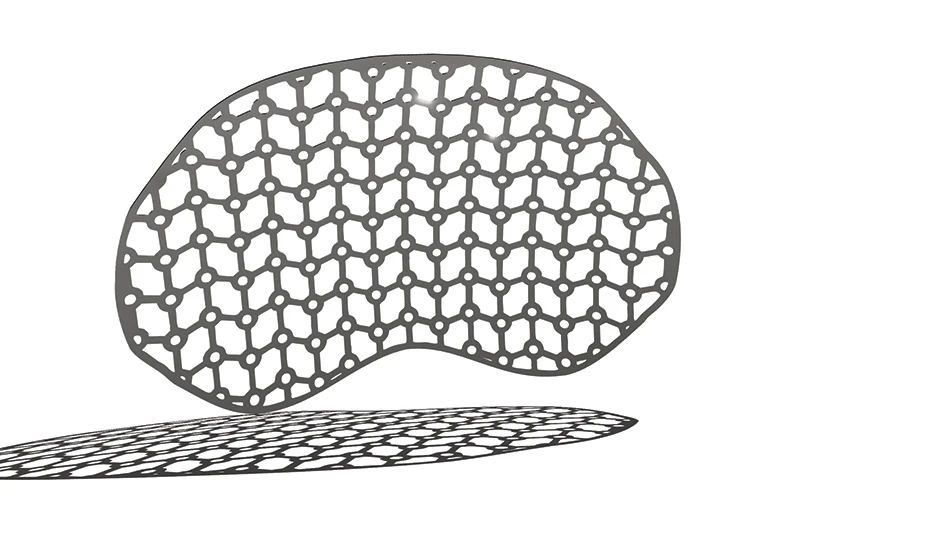
This medical illustration reveals how the SHELTER device traps and removes blood clots in the brain. Credit: Zina Deretsky, NSF
When someone suffers a stroke, time is critical – more than a million brain cells die each minute, starved of nourishment due to critical damage in a cerebral blood vessel. However, researchers have now developed a new tool for efficiently removing blood clots in the brain, the leading cause of strokes. The tool overcomes limitations in current emergency stroke treatments, potentially extending the time for a victim to get help.
Engineered with support from NSF’s Small Business Innovation Research (SBIR) program, Insera Therapeutics, Inc. of Sacramento, CA, developed the Stroke Help using an Endo-Luminal Transcatheter Embolus Retrieval (SHELTER) device, demonstrated in a recent webcast by the National Science Foundation (NSF).
Created by two brothers – Vallabh Janardhan, an interventional neurologist, and Vikram Janardhan, an engineer and the company’s CEO – SHELTER is built upon a lengthy catheter. The device contains two primary components: an outer sheath for containing captured clots and an inner filament that houses the collapsible, 5mm diameter, nickel-titanium mesh that grabs and filters the clots. To prevent accidental puncturing of blood vessels, the inner component also contains a soft, spring-like tip and a polymer safety coating.
SHELTER is the first platform to both filter and remove clots, the first to entrap the clot from both its near and far ends, and the first capable of accessing small vessels in the brain. Critically, the technology can be custom-fit for the specific length and diameter of a patient’s clot, a personalized approach that may improve treatment success.
In emergency use, an interventional neurologist would deploy SHELTER using an approach similar to other catheter-based treatments, guiding a catheter from a blood vessel in the leg to the site of the clot. The catheter would travel through the blockage – unlike blood flow, the metal device has no trouble penetrating clots – to its far side, where the net deploys. The interventional neurologist then carefully pulls the debris into a cylindrical trap that caps the outer length of the catheter.
The Janardhans improved and evaluated their system using months of simulated extractions on their unique testing apparatus. To create the apparatus, Insera contracted a company to create a transparent silicone replica from the brain vasculature of a plasticized human cadaver. Then, Insera added modifications (known in the trade as severe disease burden) to accurately represent the arteries of a real stroke victim, an environment that is much more difficult to navigate than the arteries of a standard model or a laboratory animal.
“If widely adopted, the approach could significantly cut animal testing for some medical devices and reduce overall product development costs by as much as 10%,” Vikram Janardhan states. “The silicone replica of the human brain can also be used as a humane alternative to train hundreds of physicians in the use of SHELTER.”
Insera Therapeutics Sacramento, CA www.inseratherapeutics.com
National Science Foundation Arlington, VA www.nsf.gov
Latest from Today's Medical Developments
- Stryker’s flexible syndesmotic fixation device stabilizes ankle injuries
- Mergers & acquisitions news: MGS, Quantum Surgical bolster medtech portfolios
- Exchangeable-head solid carbide cutting tools
- NextDent 300 MultiJet printer delivers a “Coming of Age for Digital Dentistry” at Evolution Dental Solutions
- Get recognized for bringing manufacturing back to North America
- Adaptive Coolant Flow improves energy efficiency
- VOLTAS opens coworking space for medical device manufacturers
- MEMS accelerometer for medical implants, wearables