CREDIT: MICHAEL MILLER/TEXAS A&M AGRILIFE
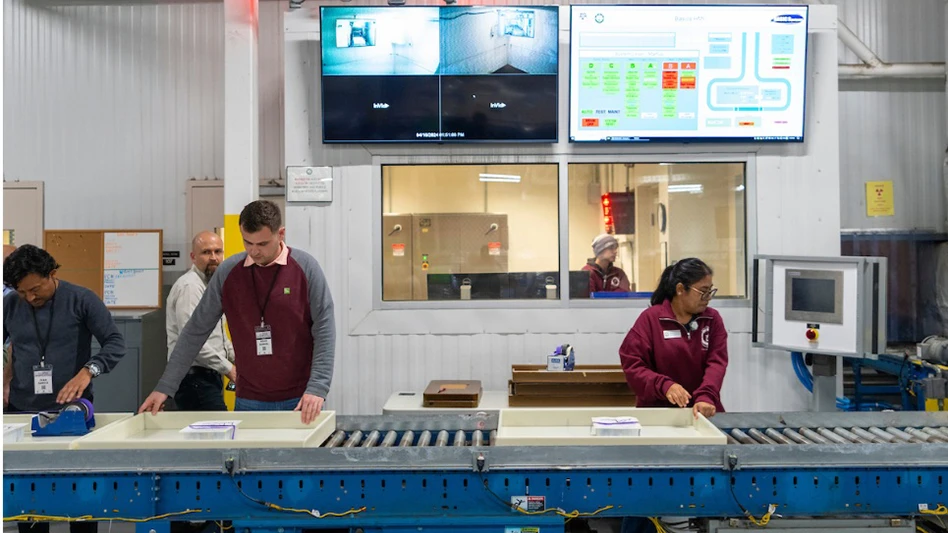
The National Center for Electron Beam Research at Texas A&M University and the U.S. Department of Energy’s National Nuclear Security Administration (NNSA) have partnered to promote the use of electron beam (eBeam) in the sterilization of medical devices.
The eBeam center, part of Texas A&M AgriLife Research, has played a leading role in advancing eBeam technology as an alternative to high-activity radioactive sources such as cobalt-60. The NNSA Office of Radiological Security (ORS) is working with Texas A&M to accelerate eBeam adoption across the medical device sterilization sector, which is essential in protecting the health and safety of the American people.
ORS works to prevent the misuse of high-activity radioactive materials by promoting advanced, non-radioisotopic, alternative technologies such as eBeam.
eBeam technology advantages
“The benefit of eBeam in these scenarios is that it can sterilize medical devices faster than traditional gamma irradiation while bypassing the risks of managing those materials,” says Suresh Pillai, Ph.D., director of the eBeam center, Bryan-College Station.
“Medical device sterilization is foundational to public health,” says Christine Bent, assistant deputy administrator for global material security at U.S. Department of Energy. “NNSA’s partnership with Texas A&M to advance eBeam technology for this purpose advances U.S. industry, prevents infection, and ensures the safety of our communities.”
With ORS support, AgriLife Research and the eBeam center are conducting feasibility studies and providing outreach and educational materials to domestic and international partners, to help drive the adoption and use of eBeam technology worldwide.
eBeam outreach and education
As part of this effort, ORS and the eBeam center hosted the annual Hands-On Electron Beam Technology Workshop in spring 2025 at Texas A&M University. The event welcomed stakeholders to engage with eBeam equipment manufacturers and receive guidance on industry adoption and use of eBeam and X-ray applications, including for medical devices.
“This partnership unites ORS’s outreach with the eBeam center’s research excellence, promoting transformative solutions that safeguard medicine and public health,” Pillai says. “We are proud to bolster ORS’s critical mission to strengthen national security.”
“Through collaboration with the eBeam center and partners around the world, NNSA strengthens national health and safety,” says Kristin Hirsch, director of ORS.
The eBeam center and ORS also work together in support of Team Nablo, a collaboration among 20 international organizations and 11 medical device manufacturers. Their mission is to bridge the information gap for stakeholders who are considering a switch from traditional radioisotopic sterilization methods to alternative technologies.
A critical player in engaging academic institutions, the eBeam center engages academic institutions to tackle information barriers to alternative technologies.
Latest from Today's Medical Developments
- How do defense industry trends affect your business?
- Guill Tool expands lab capabilities for extrusion market
- Stay ahead of the workholding technology curve
- Stryker announces limited release of handheld robotic system for knee surgery
- Fairlane Products offers variety of clutch bearing rollers
- OSSIO opens US headquarters in Florida
- Punch-laser combination machines enable precision cutting of sensitive materials
- Enlil, Interlynk to develop integrated cybersecurity solution for medical device manufacturers