AdobeStock | 342875093

You’re standing on a cleanroom floor where a single component issue can do more than disrupt production – it can put patient safety at risk. In medical device manufacturing, precision isn’t optional. Reliability and safety must be built into every decision. Many maintenance programs still rely on fixed, calendar‑based preventive intervals as a baseline approach. While this strategy has long been standard, it doesn’t always reflect how assets actually perform in high‑speed, high‑precision environments. Replacing a fully functional motor simply because it reaches a scheduled interval can drive unnecessary cost – without improving reliability.
The industry is currently pivoting toward a data-driven methodology. It’s moving past the era of break-fix and even past the limitations of simple preventive cycles. Predictive maintenance (PdM) is the expectation. Here, artificial intelligence (AI) and Internet of Things (IoT) sensors act as a connected monitoring layer across the facility. This isn't about chasing the latest tech fad; it’s a practical necessity in a highly regulated environment where ISO 13485 mandates and overall equipment effectiveness (OEE) are part of what leads to success.
Bridging the gap: Preventive vs. predictive
To navigate this shift, you have to lean into the friction between these two philosophies. Preventive maintenance is your floor, not your ceiling. It’s the scheduled lubricant swap, the routine recalibration, and those validated cleaning cycles that help keep you in compliance. It’s disciplined, sure, but it operates on fixed intervals rather than real-time equipment condition.
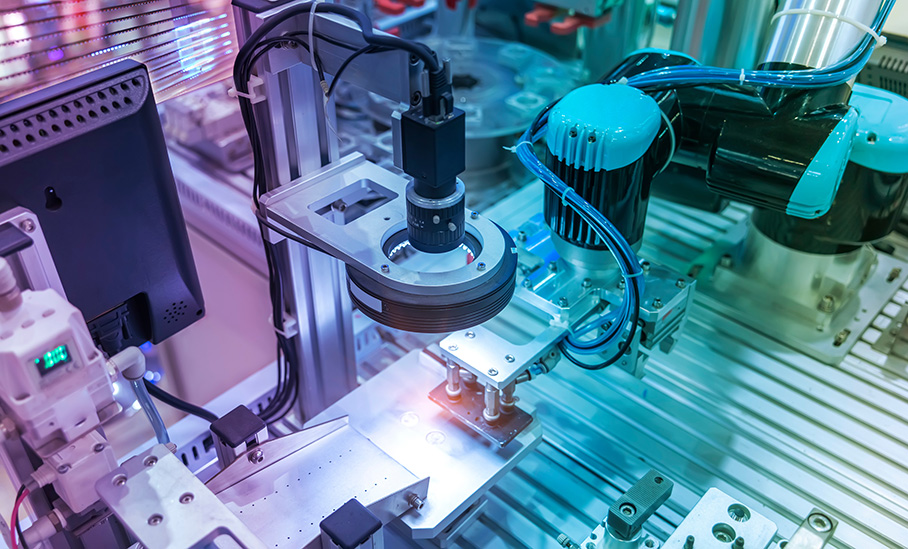
Predictive maintenance, by contrast, taps into real-time telemetry to flag exactly when a part begins to lose performance. By scattering vibration sensors, thermal probes, and acoustic monitors throughout your line, you get a transparent view of machine vitality. You aren't relying on assumptions anymore. When you combine these two approaches in favor of a hybrid model, you create a maintenance framework that addresses routine wear while catching emerging issues early.
The sensor revolution on the cleanroom floor
You’ve got to track variables that mirror the microscopic accuracy demanded by devices such as pacemakers or robotic surgical limbs. Modern IoT sensors aren't the bulky add-ons they once were. Today, they are lean, low-latency nodes piping raw data straight into your Cloud-based logic engines. If a robotic arm used in catheter assembly develops a 0.05mm deviation in its stroke, a vibration sensor detects that harmonic shift long before your quality control team spots a defective unit. This level of foresight is how you eliminate the sources of downtime and inefficiency.

However, the hardware is only half the puzzle. To actually get value from these gadgets, your crew needs rigorous technical training to decipher the mountain of data. You can't simply hand a technician a tablet and expect instant insight into the early signals of a failing spindle. They have to evolve into data-fluent specialists who can blend mechanical intuition with a digital-first perspective. This investment in human capital is what prevents your expensive AI from becoming underutilized investments.
Machine health assessments: The new audit
Before you can attempt to predict the future, you have to understand your present baseline. A comprehensive machine health assessment is your starting line. This isn't a cursory walkthrough. You need to conduct detailed assessments on your critical assets. What’s the thermal profile of your injection molding machines during peak summer months? How does the power quality fluctuate when the HVAC system kicks into high gear?
By establishing these signatures, you create a digital twin of your ideal operating state. Any deviation from this baseline triggers an alert. In the medical sector, these assessments are vital for maintaining the validated state required by the FDA. If you change a maintenance interval based on predictive data, you must have the documentation to prove that the new interval is safer and more effective than the old one. Data provides essential documentation and support during audits.
Optimizing calibration and compliance
Calibration plays a critical role in medical manufacturing. When tools such as torque drivers or laser cutters drift out of tolerance, product quality can suffer – and entire batches may be at risk. Traditionally, calibration is done on a fixed schedule. But what if your usage patterns change? What if a machine runs three shifts for a month and then sits idle for two weeks?
Predictive analytics allow you to shift to usage-based calibration. By tracking the actual stress and cycles a tool undergoes, you can extend intervals for lightly used equipment and tighten them for workhorses. This maintains high precision while reducing the downtime associated with unnecessary service. At that point, you’re not just following a checklist – you’re responding to how the material in front of you is actually behaving.
Reducing unplanned downtime and patient risk
Let’s talk about the bottom line: unplanned downtime. In a high-volume facility, an hour of offline production can cost tens of thousands of dollars or more. But in medical design, the cost is also measured in backorders. If your production of life-saving stents halts because of a predictable pump failure, you risk delays in delivery.
Predictive maintenance turns those emergencies into scheduled interventions. Instead of dealing with a failure during off-hours, your system notifies you on Friday afternoon that a motor is trending toward a fault. You schedule the repair for the weekend, swap the part, and Monday morning starts without a hitch. You’ve maintained operational continuity.
The hybrid path to operational excellence
You shouldn't scrap your preventive protocols entirely. They provide the necessary structure for regulatory adherence and basic hygiene. Instead, predictive capabilities are layered on top of preventive programs to add visibility and flexibility. This hybrid model is the hallmark of a mature manufacturing operation.
Step 1: Identify your most critical, high-failure-risk assets.
Step 2: Deploy targeted sensors (vibration, heat, pressure).
Step 3: Aggregate data to find patterns in failure modes.
Step 4: Adjust your preventive schedules based on these insights.
This iterative loop creates a self-optimizing factory. You’re no longer reacting after failures occur – you’re actively guiding performance before issues escalate.
The future is prescriptive
As AI models become more sophisticated, we move from predictive to prescriptive maintenance. The system won’t just flag an emerging failure – it can recommend corrective action and support automated parts replenishment when appropriate. For medical device manufacturers, this is a natural next logical step in strengthening quality and reliability.
You have the tools. The sensors are available, the analytics are powerful, and the stakes are high. It’s time for your maintenance approach to match the rigor and reliability demanded by modern medical device manufacturing.
About the author: Ariel Santamaria is the vice president of Reliability 360 at Advanced Technology Services and is responsible for leading and executing reliability-centered initiatives, ensuring optimal machine health and operational efficiency.
Latest from Today's Medical Developments
- Workholding Roundtable Webinar
- 3D Systems expands NextDent Jetted Denture Solution
- Carlsmed announces clinical debuts of two spinal surgery solutions
- Seco High Feed SP07 simplifies tool management
- Gore completes acquisition of Conformal Medical
- Medical textiles designed for cardiovascular, orthopedic, dental prosthetic applications
- Micro-precision 3D printing: Trends and breakthroughs in medical device manufacturing
- One-component, dual-cure adhesive system for medical device assembly